Showing posts with label climbing. Show all posts
Showing posts with label climbing. Show all posts
Tuesday, February 15, 2011
Team Bob addendum
One of the climbers on Team Bob had enough oxygen capacity left over on the summit to do a little filming. It's a good glimpse of what it might feel like up there... Enjoy!

Saturday, November 13, 2010
To the Near East
 November is the time of short days, grey skies, and rain here in the Northwest. While we're all waiting for snow to come to the mountains, the recreational shoulder season makes November the perfect time to visit family in the east and appreciate the fall leaves and cold sunny days, which we don't get much of here.
To Virginia to do a little hunting (which in deer season means a lot of sitting still and quiet in chilly wooden tree stands) and eating (mothers' jobs are to keep their children well-fed) with Dave's family, then off to West Virginia to visit Seneca Rocks and do some climbing. Believe it or not, I've never actually climbed on the east coast! My outdoor awakening began post-college, in the great Northwest, but there is plenty of good rock in those much older mountains.

We were blessed with some seriously sunny days, warm and beautiful, even one afternoon in t-shirts! The town of Seneca Rocks exists of several buildings clustered around a T-intersection - two rival guide services, two rival tourist/convenien
ce stores, and a cafe. We were able to stay at the apartment above the guide service Dave used to work for, so the approach to the rock was all of a 10-minute walk across the road. Sweet!

Seneca Rocks is a big fin of stone folded vertically into the ground, relatively solid and in a beautiful setting. Unlike many crags, this has more of a mountain feel, requiring some hiking and offering longer multi-pitch routes. And the south peak happens to be the only summit east of the Mississippi that you can't hike or scramble to, pointy enough to require ropes and technical climbing.
 Only a few days there, just long enough to get my steep-rock climbing skills back in order, then time to move on. We left the beautiful sparsely-populated valleys of West Virginia and continued the trip to visit my parents and sister. Raked leaves in Maryland, saw other of Dave's friends from guiding days, and suddenly two weeks was up, time to head back. Good to visit, see other places, catch up with old friends, and always good to head back home.
Sunday, September 26, 2010
End of summer
Sometimes summer lingers in the Cascades. There's a good rain at the beginning of September when everyone resigns themselves to going to school, work, and the returning darkness, but then it continues to be sunny through much of September and a little of October, letting those of us who can continue to play.


Sometimes it doesn't.
Word is a La Nina winter is coming, which in the northwest means more precipitation and colder temperatures than normal. Read: a good snow year. To those hoping to climb Mt Rainier in September, however, it means little hope of success this year. As of the end of this trip, no one had summited the mountain in 10 days, and it doesn't look likely in the next few.
Last week a bunch of snow fell over the course of a storm or two, and the mountain now looks ready for winter, fully cloaked in snow. This means snow angels are possible, but avalanches are as well; up to four feet of fresh snow are sitting on top of a smooth crust with the potential to slide. Not a big deal on a small slope, but on a big one, with a crevasse not too far below, it is a risk to be weighed carefully, especially when leading clients on the mountain. On my most recent trip (and last of my season), it was raining and blowing 90 miles an hour at Camp Muir at 6am. We left camp going down, not up.
But there's no such thing as bad weather, just bad clothing (well, sort of). The fall rains aren't the end of outdoor recreation, just a shift. Dave and I went for a drizzly hike up a grunt of a peak near Bellingham, and instead of flowers and mountain views, were rewarded with blueberries, a bear sighting, and plenty of solitude. What more can you ask for? When your hands get cold from picking berries, you can just hunker down and do it like the bears do...
That's the end of my Cascade season, and I'm ready for a little more stable weather. Next up, it's time to head to Nepal for Alpine's Everest Base Camp trek again. No Island Peak climb this time, just walking in more beautiful mountain terrain.
Wednesday, September 1, 2010
Four days
With six days off together in late August, Dave and I had planned a big trip, way back into the North Cascades, one of those climbs where only the first few hours are spent on a trail. In two days, climb the alpine rock route for two days, find our way out by a different cross-country route for two days. Mt Terror - mmm. But having learned our lessons about impending inclement weather and trying to cram too much into time off, we decided to change objectives and do a slightly shorter climb of equal quality - the NE buttress of Mt Goode. (Goode instead of Terror - see, we're learning...)


We drove to the trailhead on Rainy Pass the night before, looking up toward the Pickets and feeling good about not wandering around in the rain. Starting out at the PCT south trailhead, our path soon veered off that trail and up a side valley, away from the likelihood of encountering other people. Sixteen miles in, camped at the end of the trail by a beautiful river, all to ourselves. Next morning, bushwhacked and scrambled up 2000 feet to another amazing campsite, settled in, and then walked up to the start of the climb to make sure the glacier would let us pass. A few cracks to step over, but getting onto the rock was assured. Next morning we were up before light, moving early so as to start the rock climbing at first light and maximize our daylight travel time.
The NE buttress of Mt Goode is a classic but not often done route in the Cascades. It's a good ways in, and the route itself, while not necessarily difficult, is long and committing. It is 2800' of rock climbing, and retreating partway up would involve leaving a lot of gear behind. The way we went, when you reach the top you have to go down the back side of the mountain and walk all the way around, to the top of another small glacier which you descend to get back to camp. But it's in a fantastic setting, way up an unpopulated wilderness valley, long and beautiful and remote. The only people we saw were two hiking in as we were hiking out the last day.
We moved pretty well on the third- to fifth-class terrain, roped the entire time but with more or less protection as the steepness of the rock dictated. Close to the top we came across a bivy site perched on the edge of the ridge with melting snow just retreating from the edge - a perfect place to melt water and replenish for the second half of the day: getting down. On a long, hot day, it's more efficient to carry two pounds of Jetboil stove and fuel than to carry countless liters of water at two pounds per liter. We filled up all our water bottles and scoped out the decent notch before continuing on to the summit.
The Cascades continue to be one of the most beautiful places I have ever been. From the top we could see snowy volcanoes, lakes and valleys, and a sea of peaks in every direction. It is in a different quarter than most of the climbing I have done, so mountains are rearranged and showing a different side from this perch. It is staggering to think of how many things there are around us to climb, but the sun continues to move through the sky and we must begin our descent. Rappel, scramble, rappel, walk down a gully, cross some snow, hike up, cross more snow, ascend to a small pass, rappel, downclimb 50 degree snow to the glacier... turn on headlamps. Weave through crevasses, dodge more crevasses, watch the full moon rise, skirt a rock band, arrive at the slopes just above camp. Camp.
Next morning, we took a little time to appreciate the beauty of this place that cannot be described, only taken in. Then packed up, made our way back down to the valley trail, and hiked the 16 miles back to the trailhead. The beauty of a sleep-in-able vehicle is that we didn't have to go anywhere, just to sleep and listen to the returning rain on the roof of the truck.
Saturday, August 21, 2010
Six days
 One of my favorite things to do for Alpine Ascents is teach the 6-day course, a basic introduction to mountaineering skills. It's fun, entertaining, and rewarding - people with a range of skills, from none to perhaps some rock climbing background, show up on the first morning with a backpack full of gear, and by the end of 6 days they have learned how to use it. Not enough to start running up mountains by one's self, perhaps, but enough to know how to use an ice axe, which side of the crampons are up, and how to get out of a crevasse should they end up in one in ideal circumstances. Those are the basics - all the rest comes from experience.
And this time, near-perfect weather. What more can you ask for - a beautiful setting in which to hang out with ten excited, engaged, intelligent people from all over the country? Done. The views from up there are great - you're not so high that the lower peaks are distant and indistinguishable, but rather closeby and intriguing. The upper camp, termed the "honeymoon suite", looks directly across at the North Twin Sister, which Dave and I climbed a couple weeks ago. Not too shabby.

We start with the basics - various foot techniques for walking on snow, proper crampon placement, ice axe arrest (face buried in the snow, using axe and feet to stop a fall) on flatter ground for practice - then move on to finer skills. How long the rope should be between climbers, lots of different knots, belaying and rappelling on steeper slopes... These skills culminate in learning how to rescue oneself or a teammate from a crevasse, putting together all of the critical thinking and various skills learned over the past few days. Oh, and summitting the mountain, which is the more immediate goal.

I've personally never fallen in a crevasse. I've punched a foot through a snowbridge, snow that builds up to cover the crevasse and then slowly melts away in the summer. These cracks in the snow and ice of the glacier can be wide or narrow, deep or shallow, and hanging on one end of the rope or holding a fallen teammate on the other end can be equally harrowing experiences. If and when it happens, you need to know what to do, so we practice. And the practice is pretty cool - how often do you get to hang in a big crack in the ice and feel safe and secure? While the summit is an important part of the trip, this is often the highlight of the trip for students.
Playing on glaciers for 6 days with fun, motivated people for 6 days - I'll take it. (Thanks to everybody who wants to learn and keeps me doing this stuff!) They say that good judgement comes from experience, and experience comes from bad judgement, so good luck folks - be safe!
Monday, August 9, 2010
Where does the summer go??
Wow. One or two trips, a personal climb, another three trips, and all of a sudden it's three weeks later. Summer is too short, or perhaps too long, given how much I try to pack into it. Three months is a long time to be chronically sleep-deprived...


The Cascades got a ridiculous amount of snow this winter and spring, so all of the glaciers and snow slopes are still in excellent shape. This means that crevasses and ice that would normally make routes longer (having to go around them) or more technical (it's harder to climb a given angle of ice than of snow) are still covered in snow. It makes our guiding days a little shorter and a little easier; right now we have conditions that are more typical of late June/early July than of August. It's nice.
I got to climb the Kautz route (new for me) on Mt Rainer for Alpine Ascents, do a couple more laps on the Disappointment Cleaver, the standard route, and take some climbers up Mt Baker. In between, with some of that precious time off, Dave and I took a day to climb the south face of the North Twin Sister, close by Bellingham. It's a fun, relatively easy climb in a beautiful setting, and we didn't see anyone else the entire day. Perfect weather, beautiful climb, easy climbing partner - these things all help recover mentally from so much taking care of other people while guiding. Nice.
Also crammed into these three weeks was the RAMROD, Ride Around Mt Rainier in One Day, a 150-mile, 10,000' elevation gain road ride organized by a local cycling club. I remember hearing about this early in my Washington life, and thinking that this was something for people with an entirely different idea of fun than I. How was it? Fantastic. Apparently climbing is good cross-training for cycling. Tiring, yes, but I wasn't dying to get off the bike by the end, and the route goes through some really beautiful areas, both in and out of the national park. The best part? I started up a Rainier climb the next day with little more than tired muscles. Ha!
So that's a glimpse of summer in the Cascades. So much to do. Such limited time in the sunshine. It's a good thing it starts to rain again sometime in September/October, or we wouldn't be able to keep up with our bodies! Sleep is good...
Saturday, July 17, 2010
Forbidden Torment
If there was a climb called Forbidden-Torment, you'd want to climb it, right?


Several years ago, Mary said "I want to climb Forbidden." It is a well-known climb in the North Cascades, classic easy-moderate rock in a beautiful alpine setting, way up in the high mountains on a ridge with views of mountains and lakes and forests and pointy rocks all around. I said, "how about the Forbidden-Torment traverse?"
This traverse is, among other things, featured in a coffee table book called "50 Classic Climbs" which popularized some beautiful climbs, many of them not prohibitively difficult for your average climber. It is a mile-long pointy ridge between Mt Torment and Mt Forbidden, and requires both technical rock climbing skills and commitment to the route - once you rappel onto the north side of the ridge from Torment, it is prohibitively difficult to get off the ridge without continuing to Forbidden at the other end.
Four years ago Mary and I got caught in an ice-storm up there, and were on the traverse for four days instead of our planned two, just continuing to climb the ice-coated ridge in zero visibility so we could get off. We ran out of food and were at times very concerned about hypothermia - it's the first time I've actually contemplated the possibility of dying in the mountains. (The above picture is of Mary on that first attempt.) But we made it down in one piece, and came up one other time to attempt the route before turning around.
This time, Mary led the hardest part - getting off the glacier and onto the rock - and we headed for the top of Torment. Unfortunately, we haven't done much climbing together recently, and in the end we were moving too slow to anticipate a good climb - the time we had would not permit us to have normal-length days and achieve our objective. We'd done the traverse itself once, though it wasn't fun. If we weren't enjoying this climb, why were we doing it? So we came down and camped with the marmots, and enjoyed the sunset.
Next time Mary says "I want to climb this mountain," I'm just going to say, "OK."
Friday, July 9, 2010
Vantage and Baker
 So this might not be the kind of climbing that inspires dramatic posts. It was not hard, it was not impressive. It wasn't something new or different, in fact I think I've climbed most of what we did before. But it has been some time for me and Mary and Erin, both since we climbed individually and since we got to play together. Which means... things got a little ridiculous.
The three of us have climbed Rainier in tiaras, and basically find joint ventures to be an excuse to indulge our inner 12-year-olds. Or younger in this case - we got silly stretchy bracelets and temporary tattoos and just enjoyed a sunny weekend in the desert of Eastern Washington with the excuse of doing some rock climbing. Really, what more do you need? Our original plan had been to climb Mt Baker with a couple other folks, but the forecast was for rain, and we found out later that's exactly what it did - boy was it nice to be in the hot and dry! It had been a pretty crappy spring here in the Northwest so far.

A week later, the switch for summer flipped here, and it was beautiful everywhere. So I did go to Mt Baker, but this time with skis. Dave and two of his friends and I went up to ski the Squak Glacier - an ancient native name for "glacier without big crevasses". The snowline was finally rising, so we had to cross the lowland rivers and hike up to the snow. From there it was a mellow day, just skiing up as high as we wanted and then making big turns down the vast canvas of the unbroken snow. Sweet!! More weather like this, please!

Thursday, July 1, 2010
Working?
 OK, so I had a little time off, and it was (of course) promptly filled with those day-to-day things that most people take for granted, but which are impossible to do while on the hill. Catching up on life stuff, and a little fun thrown in for good measure: manage the email (obviously), sleep, do laundry, spend time with boyfriend/partner Dave, go skiing, work one Rainier climb, get a haircut, do a few RAMROD training rides, catch up with a few friends in town...
There's always plenty to do, but as with all lives, it becomes part of the day-to-day, strange as that may sound. After the chaos of the RAAM, it was nice to have my time back for a little while.
Wednesday, May 5, 2010
Those last 15 feet...
It's funny - I put in my last cybercast from Nepal about two weeks ago, and just finished typing up the first one for Denali. For being somewhere else all the time, I sure feel like I'm always letting people know where I am!
Island Peak stands at 20,305 feet above sea level. We were joking while we were there that we should just bring a really tall ladder to make it to the same elevation as the summit of Denali, which is at 20,320', and how different the two climbs were. Island: a different language, rocky trails, animals to carry your gear, people to cook your food and carry the kitchen, a day from base camp to the summit. Denali: US land, entirely ice from the moment you start, 120 lbs of gear that you are responsible for moving up the mountain, a shovel for making your own sleeping place level (and protected from wind and snow), and 15+ days of walking slowly uphill carrying lots of weight, hoping the weather will give you a break so you can go back down. It would be difficult for them to be more different, but it's all the mountains, and it's all good.
So we're off, weather permitting, tomorrow afternoon. We'll spend the next full day at base camp, by the snow runway, going over crevasse rescue and building a strong camp and all the other stuff we need to be ready for the mountain. It will be a few days until we have phone reception and can call in again, but posts, as always, will be at www.alpineascents.com/denali-cybercast.asp See you soon!
Island Peak stands at 20,305 feet above sea level. We were joking while we were there that we should just bring a really tall ladder to make it to the same elevation as the summit of Denali, which is at 20,320', and how different the two climbs were. Island: a different language, rocky trails, animals to carry your gear, people to cook your food and carry the kitchen, a day from base camp to the summit. Denali: US land, entirely ice from the moment you start, 120 lbs of gear that you are responsible for moving up the mountain, a shovel for making your own sleeping place level (and protected from wind and snow), and 15+ days of walking slowly uphill carrying lots of weight, hoping the weather will give you a break so you can go back down. It would be difficult for them to be more different, but it's all the mountains, and it's all good.
So we're off, weather permitting, tomorrow afternoon. We'll spend the next full day at base camp, by the snow runway, going over crevasse rescue and building a strong camp and all the other stuff we need to be ready for the mountain. It will be a few days until we have phone reception and can call in again, but posts, as always, will be at www.alpineascents.com/denali-cybercast.asp See you soon!
Wednesday, April 21, 2010
Everest Base Camp / Island Peak
Three weeks? Really? Yep, we flew in on April 1 and back on April 20 - three weeks of walking up and down paths, looking at mountains and trees and yaks and kids and trying hard to fight off the various intestinal and respiratory bugs along the way. To Everest Base Camp and back, and a side trip to climb Island Peak for a few of us.
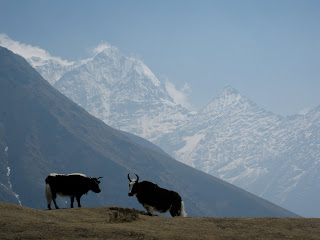
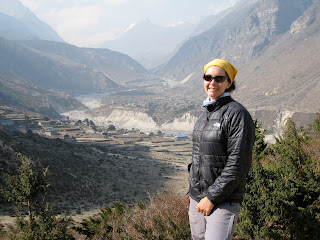
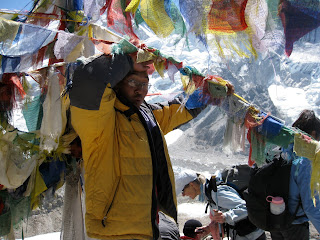

We actually had ridiculously perfect weather for most of the trek, just an afternoon of showers for us climbers and, unfortunately, some bad weather for the trekkers trying to fly back to Kathmandu before us. But the good weather meant lots of iconic views of all the famous mountains, Everest, Lhotse, Nupse, Ama Dablam, Pumori, as well as the less-famous mountains: Kangteka, Tamserku, Island, etc. The high Himalaya really are what they appear to be in pictures - striking, isolated, and BIG. Add some colorful prayer flags and timeless chorten monuments and stoic-looking yaks, and every picture is a keeper.
Interestingly, the challenge in climbing Everest is increasingly becoming not the altitude or logistics (that's what extra oxygen and amazing Sherpas are for), but simply keeping healthy in a valley with hundreds of climbers from all over the world (and thousands of trekkers), plentiful antibiotics, and lots of years for things to stew in a confined area. Everyone on our trip was sick in some form for some amount of time, and a few were hit badly enough to have to discontinue their ascent, meeting us only on the way down. Acute gastroenteritis (shit-barfs in the coloquial), respiratory infections, and the elusive Khumbu cough, a dry cough that doesn't resolve until you go down a LOT - these are often incapacitating and occasionally immune to antibiotic treatment. So train, yes, but carry a lot of drugs.
The main trekking route is indeed a Disneyland of sorts, and being in a large group made things much easier in many ways. The Sherpas (historical traders from Tibet who settled in the high valleys of Nepal about 500 years ago and are extremely strong at altitude) who porter, guide, and organize for us are amazingly hard working and attentive, and will run ahead to get tea or lunch started, load duffels on yaks, put bags in rooms, and a thousand other things that make our lives smoother. Most of them have a long relationship with Alpine Ascents, and the generosity of spirit they show is amazing.
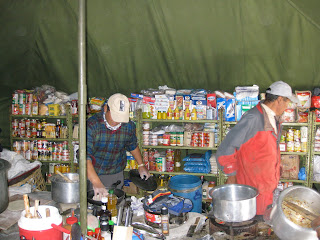
We trekked up with the team of Everest climbers and guides who would be staying and climbing on the mountain for the next six weeks. It was a big group, but nice to get to talk to a variety of people, and interesting to get to know the climbers a bit before wishing them luck and heading back down. We had the opportunity to have lunch in base camp before heading back down, and the digs are nice!! They're there for some time, so the facilities (dining tent, outhouses, tents) are nice, and the food was great. We walked up close to the famous Khumbu icefall, a maze of shifting, broken glacier, and all agreed that we were glad we wouldn't have to walk through it!
A few odd things: after leaving the little airport at Lukla, we didn't see another wheel or cart until we returned. The terrain is too steep and broken - everything is carried by humans or yaks (or mule or zopkyo, a yak/cow crossbreed). And for many days we never heard an engine - no generators, no flights overhead. It is odd to realize that you haven't heard anything far away except for rockfall - everything you hear is close to you, within eyeshot. Yet there was internet in literally all but two of the villages we stayed in - ha!
The rest of the trekkers headed down and four of us (one had gotten quite sick) took a 5-day side trip to climb Island Peak, only 15 feet shorter than Denali! But so much more accessible. It's rock and trail about 2/3 of the way up, then a bit of glacier and at last some steep ice, which Chewang went ahead and fixed ropes on so we could climb up safely. Nice to be on a mountain instead of down in the valleys for a while!
Back down here in Kathmandu, a good rain had cleared out the smog, so it wasn't so much of a shock to our system. Amazing how fast you can readjust to cars and signs and civilization. A good shower, some fresh fruit, and cotton, and it's almost like we never left. But it's interesting to have seen another corner of the world, another cultural reference that people talk about, another understanding of a common experience. I managed not to offend any locals too much, or accidentally do anything terribly sacrilegious, so hopefully I'll get to come back and lead this trip in the future...
Tuesday, December 1, 2009
A five-hour delay in the Delhi airport
Is it possible to miss a place before you've even left?? How do you reconcile yourself to your world, to your own choices, when they exact their toll? Oddly enough, I'm not talking about love, though the parallels are certainly there. Love or life, the loss is part of the having.

These last three trips to India have been spent developing stronger and stronger ties to a place that's literally half a world away, that doesn't hold lucrative work for me, that is in many ways diametrically opposed to the culture I call home. But each time I come I meet more cool people, those I want to see again, and find more things I want to do with those I already know well. In Indian parlance, "what to do?" The only answer is to keep coming back.

OK, enough of the philosophical rant. This last week in Bangalore has been exactly what I've needed at the end of every trip here, a little time in a place I'm coming to know better, with no demands except those I willingly submit to. To and from a climbing area, I rode pillion (second) on a motorcycle for only the second time, with just my bicycle helmet - better than nothing. A friend generously loaned his road bike, this time the perfect size, and I learned how to get around (just a tiny bit of) the city by bicycle - while traffic is chaos, at least that means drivers are somewhat used to looking out for motorcycles, cyclists, cows, etc, and won't run you over without even noticing! Ironic.

I did manage to go rock climbing (sometimes no one's available, and you just have to hire a guide :-) at one of the more beautiful locations I've been to, Ramanagar, about an hour outside Bangalore. The city is in one section of a huge plateau punctuated by tall rounded rock outcroppings, around 500' high. Many of these have ruins of forts, or temples on them. Ramanagar supports a temple and a few other structures, pavilions. It has also been developed by the local climbing community into a climbing area, complete with new bolts for leading and anchoring, and a variety of routes from easy to extremely hard. It's not a terribly large area, but one wall was plenty to remind my fingers that they haven't done much climbing recently! Fortunately that allowed for some time to look around, out at the plateau and the other rock bumps in the greenery. A beautiful day.
So now, headed back to Seattle, I'm mentally preparing for the shift in time, culture, friends, and the little interactions that make a place home, looking forward to briefly seeing good friends there, but missing those here I won't see for a while. Ah, well - til next time...
Thursday, November 12, 2009
Made it...
Wow - that was definitely interesting. I learned a ton of old-school and expedition-specific techniques, a bunch more Hindi, and the names of about a quarter of the students. I thought remembering eight English names on a 3-day Rainier climb was hard...

A three-day march brought us to Base Camp, complete with generator and electric lights, 10-person canvas tents, a stone shelter with propane stoves, a cook staff, and the biggest pressure cooker pot I've ever seen. Porters carried up daily fresh vegetables and eggs, and the ten goats I watched being weighed at our first camp were regularly made into mutton stew. (I love the idea of being able to pet my, or my fellow climbers', dinner's fuzzy nose.) Once a week there was even a "mail run" - money could be given to a porter who would bring back sweets or TP the next day! Crazy expedition stuff.

Over 18 days of hiking in and practicing around Base Camp we covered ice climbing, crevasse crossing, basic snow skills, navigation, and height gain. Some things were the same, some from about 20 years ago, and a few things were just straight-up new to me. Such a strange mix of old and new techniques. Fortunately, a guy who works with a climbing-certification organization paid a visit as well, so I wasn't the only person insisting on crazy things like manufacturer-specified angles of ice-screw placement.

And despite being the "slow" instructor, both in the speed of my students and my non-understanding of daily instructions in Hindi, everyone was great, super helpful and largely indulgent of my ignorance of daily camp workings. On top of it, I had to take my turn as Duty Instructor, responsible for making sure everything happens on time and in line. But I don't know what I'm supposed to be ordering or finding out during morning parade, let along the Hindi words for "attention" and "at ease"... (Actually, I do now - Sabdan and Vishram, in case you ever need to know.) One of the hardest things I've ever done, truthfully - maintaining a (relatively) even keel through not knowing what's going on, trying to suggest improvements while not being condescending, and generally having to sit back and watch a situation I would normally be at least partially in charge of run completely differently.
My basic goal of understanding more of how climbing works here has definitely been accomplished. Larger goals will come with time - I intend to do more with the programs here, though I'm not sure yet in what capacity or timeframe. Down from the mountains now, we're back to more ceremony and logistical management than activity, and I'm about ready to go. A couple more days of graduation rehearsals, assessments, etc, and I'll be on my own again, in charge of my own time. Amazing how important that is when you don't have it.
Saturday, October 24, 2009
79 Rock-Climbing Students on the Wall
(...sung to the tune of 99 Bottles of Beer) A week here at NIM's Basic Mountaineering course has gone relatively smoothly and we're about to head up into the mountains for 18 days of mountain skills. The last week has been spent on logistics and basic rock climbing skills, and it's time to find some snow.


All in all, I'm actually pleasantly surprised by the whole system. I'd heard many things about the army-based teaching system and the comparative isolation of the climbing community and techniques here. But despite some rather old-school equipment (gear is not only subject to up to 50% import duty, but comparatively very expensive relative to earnings) and techniques (I've never actually done a shoulder-body rappel!) the teaching progression is quite good and remarkably effective for a group of 79 students!
This group is broken into rope teams of 5-7 students, each with an assigned instructor for practice sessions. So there's a lecture on rappeling, for instance, then I take my 6 ladies (17-40 years of age, 3 different languages) and we practice the skill. Always with some time constraint, but with the ability to show details and ask questions. Turns out, this is the first Basic course that has been offered co-ed. There is always (has been since the founding in 1968, admirably) a women-only course, but just one a year. So this is an experiment in mixing the Basic course; usually only the very advanced courses like Search and Rescue are mixed. So far it seems to be going well - my group is usually slower (than the guys or the other women), but the instructors have made the logistics work around this really well.
On the flip side, I've learned things like how to rappel with a rock hammer, normally used to place pitons (amazed picture with one of two foreign students, right), pack with canvas stuff sacks, and sit separately from the students. I've gotten slightly used to being addressed as "madam" in India, but it's proscribed here by the military setup of the place - students and instructors/staff are very much separated. They get their cafeteria food (Indian curries and chappatis) by standing in line past a serving window, we get to sit at a table and have it brought to us. I understand why it works this way, and it does work, it's just tough for someone who never (never?) thinks of herself as better or more worthy of not sitting on the ground than anyone else.
So things are good, and we're headed up into the mountains for 18 days tomorrow. Porters, canvas tents, afternoon tea, and some time up high! See you soon...
Wednesday, July 29, 2009
Bonanza!
 Mary and I had been talking about this mountain, highest non-volcanic peak in Washington, for a while, and she had been there previously with a friend who convinced them not to bring the right equipment. It's located on the eastern side of the Cascades, and we decided to go the long way, 22 miles through an area called Spider Gap which I'd heard was beautiful, instead of the "short" way up Lake Chelan and through Holden Village.
Forecast: Hot and sunny. Sweet! We crossed over Spider Gap early the second day to some amazing clouds pouring over the mountains to the east. Beautiful meadows down below, amazing alpine lakes, and dramatic peaks for a backdrop. Hmm. Wonder what those clouds are going to do...

On the third day we bushwhacked around the head of the lake and up the classic Cascade configuration of scree field, rocky cliff, start of glacier, crevasse navigation, and dicey transition to rock. We'd heard many things about the rock - loose, hard, easy... In the end, it was a great 4th class scramble (ie no ropes needed, but don't fall) up fun features to the sharp ridge and summit.
Unfortunately, the vista that greeted us as we gained the ridge included a big thunderstorm not too far away and headed, yes, directly for us! We don't get thunderstorms much here, hardly at all, but the unusually hot weather was breeding cells in the east that were moving west.

After a few minutes on the summit trying to convince us both that it wasn't headed straight toward us, we got off there as quickly as possible - I had never had a near thunderstorm experience, and was entirely OK with that!
The rain started as I headed down the first rappel, light and sound coming closer and closer together as the storm moved in. I was at the next station getting the rope sorted out when that characteristic buzzing started (more like a series of tiny pops between the metal in my helmet) and saw and heard the strike at exactly the same time. Looking up 150' of rope to where Mary was still perched on the ridge, just 40' below the summit, I yelled up, "Are you OK??" She was, though we're both pretty convinced it hit the summit, just meters from where she was. Wow.

She came down and we continued rappelling as the rain eventually stopped and the storm moved on. Another cell just side-swiped us, dropping a little rain but no big strikes. Whew! We took our time down the rest of the route, making our way back to camp in the dark.
The walk out gave us more of the afternoon-rainshower experience as we passed many dayhikers from nearby Holden on our hike out the long way. My favorite image: five cotton-clad hikers smooshed in next to a tree trunk, doing their best to hide from the downpour and stay warm before making a 6-mile dash for it. I donned my garbage bag-cum-rain skirt and we walked on...
Sunday, November 2, 2008
Bangalore
 Spent a week in Bangalore visiting friends from the bike race, doing a little climbing, a little running, a little biking, and meeting their friends in the city. The camera charger I got to replace my missing one wasn’t exactly functional, so I’m again lacking pictures, but am hoping other folks who took some will come through.
Walking past a climbing wall outside Kanteerava stadium my first day, I saw three women resting at the base – three Indian women, climbing! I talked to them for a bit, and they turned out to be two of the South Indian climbing champions, headed to nationals in Delhi next month. They were the first outgoing Indian women I’ve met yet, and it turned out that one of them was our guide for a day of bouldering south of the city later that week. Shanti was an amazing climber, fun to watch, harder to emulate, and always encouraging.
 Having brought my shoes and pedals, I borrowed a bike to join Samim and Nilesh and Rohan for a ride at Nandi Hills – Sam rode there, caught up with us on the hill, and rode back to Bangalore while we took the car to the bottom of the hill to ride up and single-track down. Nellie really wants to develop the mountain biking in the area, so they negotiated with a local woman to figure out when and how ladders could be built to make a few too-rocky sections ridable.
Otherwise, spent my time running in the morning with Sriram and other new friends who recognized me on the path (nice to be overly conspicuous sometimes!), seeing a few sights, and wandering around my area of the city. One evening I got to be the trailing car for a ride to Nandi hills! Driving on the wrong side of the road wasn’t bad, as I was following them at cycle speed to keep everyone from getting run over by traffic – exciting nonetheless.
 Now back to Delhi for a cycle friend’s brother’s wedding – should be interesting, as I haven’t seen the whole Indian wedding scene yet. Meeting up for lunch with a client from this summer who was climbing Island Peak with Alpine Ascents in Nepal and is flying out of Delhi the same day I am. What a funny, tiny world! Still haven’t seen the Taj Mahal, let along Rajastan, Goa, Sikkim… I’ll have to come back.
Monday, October 27, 2008
Hands on rock
Note: Lin generously supplied photos due to a mis-match of my technology. I promise to put more up next week on returning to Delhi...
 There are times when it seems like the whole world has been discovered, mapped, tapped, and been-there-done-that, looking for the next thing. But if there has been one overriding theme here for me, it's that the natural places of India haven't been tapped at all. Toni, Japanese, living in Hyderabad, has been developing boulder problems in the large rocks just four minute's walk from his apartment. He's working to map climbing problems, meet and encourage new climbers, and help protect the park from development, a serious threat in this rapidly expanding tech-boom city. Solang sees an incredibly small amount of mountaineering traffic, and has tons of potential for un-skied backcountry terrain. The climbing in Hampi is practically limitless, and there is rock in Mumbai, Pune, Bangalore...
 I forgot how fun it is to climb when you've actually been practicing! Two days in H'bad, four days on the sharpstone in Hampi - this might be more rock than I've been on all year! My (and Lin's and Nishit's) fingertips got hashed for a few days, but now they're starting to toughen into the callouses I used to know. I'd better get out onto the artifical wall here in Bangalore tomorrow, just to use them.
Hampi was a really neat place - I'd heard lots of serious climbers talking about it, read about epic trips there, but didn't really know what to expect in terms of terrain, people, climbing, etc. The town itself is based around ruins from about 1350-1550 AD (I think), with tourists of all nationalities coming to see temples, carvings, etc scattered from the main center on the river to sites many kilometers away. But on the other side of the river there are still rice fields and water buffalo, graceful white birds and bananas and papaya being sold by the road. The climbers all stay here, where it is peaceful and quiet and less than half an hour's walk from the clean-enough (maybe) tin-roofed room you've paid just two to ten dollars for, mosquitos and all. So what that the power is off daily until noon, and again from 6-7pm? Food is cheap, you can avoid the stoned Israeli population with a little work, and there's really not a lot else you have to do. A local rock guide (the only one!) showed me and Lin some easier problems, then we hooked up with bike-race friend Nishit and his mentor friend for some problems that made me remember how good it is to finish a challenging line. My fingers are a little torn up from the sharp granite, but it feels great.
 The funny thing? The guide and our two friends (from Pune) were the only Indian climbers in the whole place. The season is just starting, so things aren't crowded yet, but of the 20-25 climbers I met and saw, they were the only ones! There are plenty of historical and social and economic reasons for this that I could ramble about for a while, but here I'll just say that I look forward to an expanding national climbing community growing from the work and encouragement of those who are out there. Keep climbing.
 There are times when it seems like the whole world has been discovered, mapped, tapped, and been-there-done-that, looking for the next thing. But if there has been one overriding theme here for me, it's that the natural places of India haven't been tapped at all. Toni, Japanese, living in Hyderabad, has been developing boulder problems in the large rocks just four minute's walk from his apartment. He's working to map climbing problems, meet and encourage new climbers, and help protect the park from development, a serious threat in this rapidly expanding tech-boom city. Solang sees an incredibly small amount of mountaineering traffic, and has tons of potential for un-skied backcountry terrain. The climbing in Hampi is practically limitless, and there is rock in Mumbai, Pune, Bangalore...
 I forgot how fun it is to climb when you've actually been practicing! Two days in H'bad, four days on the sharpstone in Hampi - this might be more rock than I've been on all year! My (and Lin's and Nishit's) fingertips got hashed for a few days, but now they're starting to toughen into the callouses I used to know. I'd better get out onto the artifical wall here in Bangalore tomorrow, just to use them.
Hampi was a really neat place - I'd heard lots of serious climbers talking about it, read about epic trips there, but didn't really know what to expect in terms of terrain, people, climbing, etc. The town itself is based around ruins from about 1350-1550 AD (I think), with tourists of all
 nationalities coming to see temples, carvings, etc scattered from the main center on the river to sites many kilometers away. But on the other side of the river there are still rice fields and water buffalo, graceful white birds and bananas and papaya being sold by the road. The climbers all stay here, where it is peaceful and quiet and less than half an hour's walk from the clean-enough (maybe) tin-roofed room you've paid just two to ten dollars for, mosquitos and all. So what that the power is off daily until noon, and again from 6-7pm? Food is cheap, you can avoid the stoned Israeli population with a little work, and there's really not a lot else you have to do. A local rock guide (the only one!) showed me and Lin some easier problems, then we hooked up with bike-race friend Nishit and his mentor friend for some problems that made me remember how good it is to finish a challenging line. My fingers are a little torn up from the sharp granite, but it feels great.
 The funny thing? The guide and our two friends (from Pune) were the only Indian climbers in the whole place. The season is just starting, so things aren't crowded yet, but of the 20-25 climbers I met and saw, they were the only ones! There are plenty of historical and social and economic reasons for this that I could ramble about for a while, but here I'll just say that I look forward to an expanding national climbing community growing from the work and encouragement of those who are out there. Keep climbing.
Subscribe to:
Posts (Atom)
